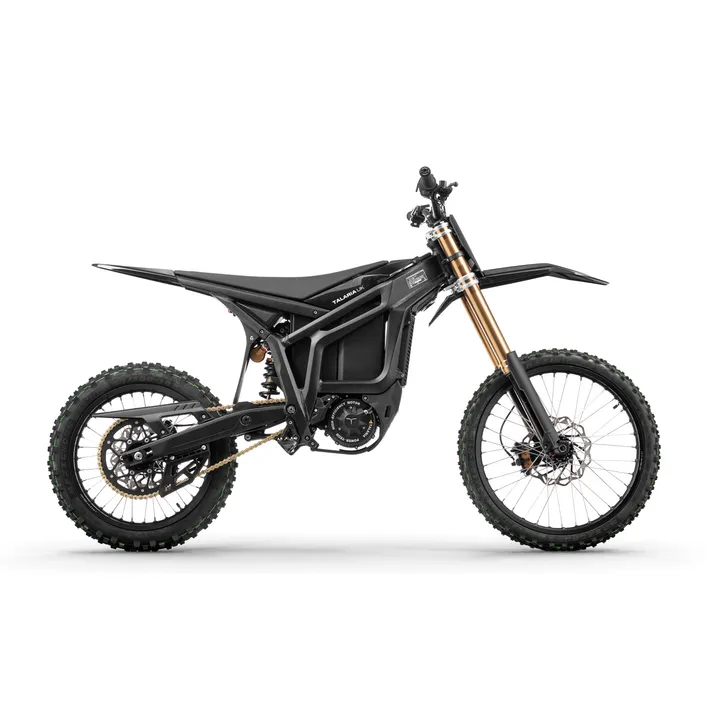
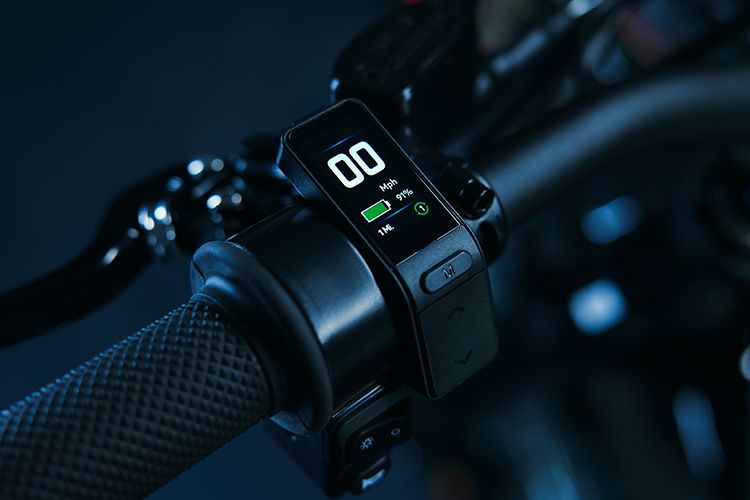
The battery is the single most expensive component on any Talaria, and the charger is the thing most likely to be lost, borrowed or replaced with something unsuitable. This guide answers what UK owners actually ask about the Talaria battery and Talaria charger — real numbers, per model, plus the handful of habits that decide whether a pack lasts three years or eight.
Talaria battery and charging times by model
| Model | Battery pack | Charge time | Claimed range |
|---|---|---|---|
| Talaria X3 MX Pro (TL2500-V2) | 60 V 40 Ah, LG cells | ~4 hours | 50 miles |
| Talaria Sting R (MX4) | 60 V 45 Ah, LG cells | ~3 hours (0–100%) | 52 miles |
| Talaria Sting Pro (MX5) | 72 V 40 Ah, LG cells | ~3 hours (0–100%) | 52 miles |
| Talaria Komodo | 97.2 V 45 Ah | ~4 hours | 71 miles |
| Talaria JR-12 (ET01) | 22 V 5 Ah | 2.5 hours | 9.3 miles |
| Talaria JR-16 (ET01P) | 22 V 10 Ah | 1.4 hours | 15.5 miles |
Two things to note. First, the Sting R actually carries the largest amp-hour pack in the mid-range at 45 Ah — the Sting Pro trades a little capacity for a higher 72 V bus and more power. Second, those range figures are manufacturer numbers measured at steady moderate speed. Ridden hard off-road, expect roughly half the quoted figure; that is normal for every brand.
60 V, 72 V or 97 V — what the voltage actually changes
Voltage is what lets a motor make power without melting. Higher voltage means the same power at lower current, so less heat in the controller and wiring.
- 60 V (X3 Pro, Sting R) — efficient, gentle on components, ideal for trail and learner use.
- 72 V (Sting Pro) — the sweet spot for hard riding. Noticeably stronger mid-range punch.
- 97.2 V (Komodo) — genuine motocross territory, supporting 32 kW and 754 Nm.
A higher-voltage pack is not a drop-in upgrade. The controller, wiring and BMS are matched to the pack, which is why “72 V conversion” kits sold online so often end up cooking a controller.
Looking after a Talaria battery
Lithium packs do not die of old age so much as of habit. Five that matter:
- Do not store it full or empty. For anything longer than a week, leave the pack around 50–60% charge.
- Let it cool before charging. A pack straight off a hard session is warm; give it 30 minutes.
- Charge somewhere sensible. Never in a hallway, doorway or the only escape route from a building, and never unattended overnight. This is the single biggest safety point in this guide.
- Keep it dry at the connector. Talarias handle wet trails fine, but pressure-washing directly into the battery bay or charge port is asking for corrosion.
- Ride it. A pack left untouched for six months degrades faster than one used weekly.
Cold weather temporarily reduces range — expect 10–20% less on a near-freezing day. It returns when the pack warms up; nothing is wrong.
Choosing a Talaria charger
The supplied charger is matched to your model’s voltage and connector. If you need a spare or a replacement:
- Match the model, not just the voltage. A 72 V Sting Pro charger will not correctly serve a 60 V Sting R.
- Buy genuine. Uncertified chargers are the most common cause of pack damage, and using one will invalidate warranty cover on the battery.
- A second charger is genuinely useful if you ride away from home — many owners keep one in the van.
Genuine chargers, replacement packs and battery-bay hardware for every model are in the Talaria UK parts shop, filtered by model so you cannot order the wrong voltage.
When a battery needs replacing
Signs a pack is near the end of its useful life: range has dropped well below half of new, the bike cuts out under load with charge still showing, or the pack reads full and then collapses within a mile. If you see any physical swelling, stop using it immediately and contact us — do not charge a swollen pack.
Keep the rest of the bike healthy too: our Talaria maintenance and battery care tips cover gearbox oil, chain care and the pre-ride checks that prevent most failures, and running costs shows what a charge actually costs at UK electricity prices.
Frequently asked questions
How long does a Talaria battery take to charge?
With the supplied charger, the Talaria Sting R and Sting Pro take about 3 hours for a full 0–100% charge, the X3 Pro about 4 hours, and the Komodo approximately 4 hours. The junior JR-12 takes 2.5 hours and the JR-16 about 1.4 hours.
How long does a Talaria battery last?
Per charge, expect around 50–52 miles from the Sting R, Sting Pro and X3 Pro, and about 71 miles from the Komodo — though hard off-road riding cuts that significantly. Over its lifetime a well-treated lithium pack should hold most of its usable capacity for several hundred full cycles.
What voltage is a Talaria battery?
It varies by model. The Talaria X3 Pro and Sting R use a 60 V pack (40 Ah and 45 Ah respectively), the Sting Pro uses 72 V 40 Ah with LG cells, and the Komodo runs a 97.2 V 45 Ah pack. The junior JR-12 and JR-16 use small 22 V packs.
Can I leave my Talaria on charge overnight?
It is better not to make a habit of it. The charger stops when the pack is full, but lithium packs are happiest stored between roughly 30% and 80% rather than sitting at 100%. Charge to full before a ride rather than days in advance, and never charge an unattended bike in a hallway or doorway.
Where can I buy a genuine Talaria charger?
Genuine Talaria chargers and replacement batteries for every model are available from the Talaria UK parts shop, matched to your model so the voltage and connector are correct. Using a mismatched or uncertified charger risks damaging the pack and voids warranty cover.
Models mentioned in this guide
- Talaria Sting R More power, more performance. The all-new air-cooled Sting R is the industry-leading electric dirt bike for UK riders.
- Talaria Sting Pro The ultimate Sting. 72 V performance, 13 kW peak power and a fully overhauled chassis.
- Talaria Komodo Own the horizon. 32 kW peak, 754 Nm of torque and 0–60 mph in 4.5 seconds — the apex of the Talaria range.